On-shore Fishing Spots || Our sophisticated data-driven algorithms will now suggest potential locations where honey holes can be located from the bank. A game changing feature when it comes to planning your session or when you want to change the spot and need a quick decision!
Boat Ramp Locations || Forget about scouring areal maps looking for a place where you can get your boat in the water. Whether it’s a manmade ramp on a massive lake or a suitable riverbank with road access – you’ll be sure to find it with Fish Deeper Premium!
7-DAY TRIAL || Yes, you can put these features to a test completely free for a week! Make sure to activate your Premium access the next time you’re planning to hit the water!
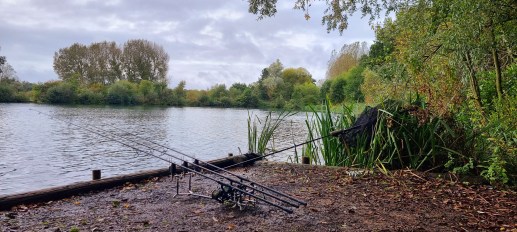
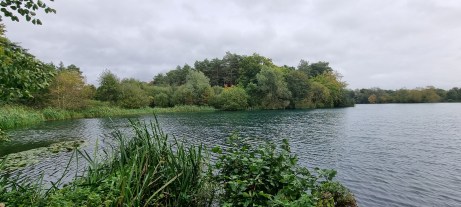
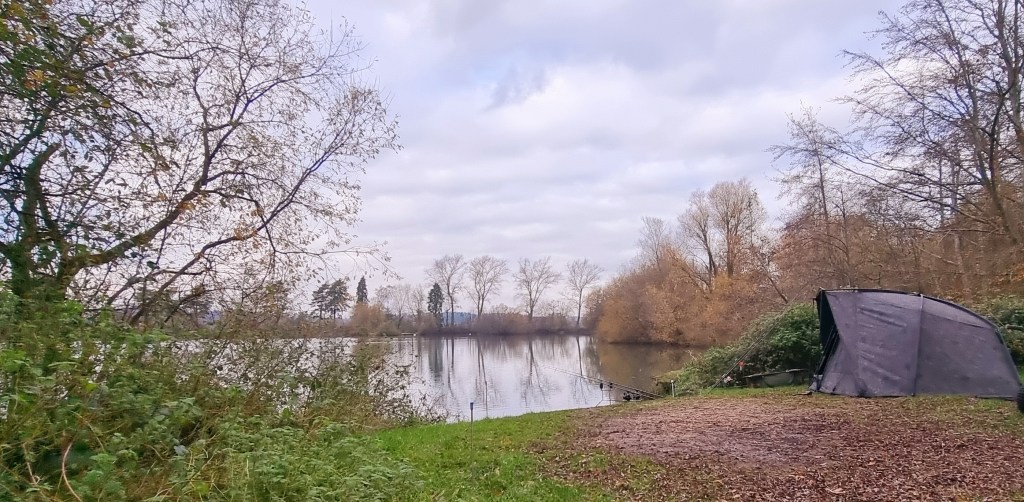
This trip, I found myself back at West Stow Country Park for my annual get-together with my old friend, Rob Nunn. After last year’s unfortunate encounter with COVID-19 that forced me to cut my trip short, I’m hoping for a smoother experience this time around.
My day began early, with me waking up just after 4 a.m. and hitting the road by 4:30, embarking on a roughly three-hour drive. The early start was worth it, though, as I made swift progress on the M3 and around the M25. It felt like driving back in the good old days when there wasn’t as much congestion. The M25 has now expanded to four lanes, but I still couldn’t escape the occasional road hogs in the middle lanes, or as they’ve now evolved, the third and fourth lane brigade. Some things never change.
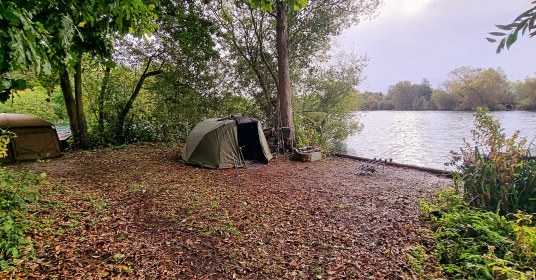
Arriving a little after 7 a.m., I was pleasantly surprised to find Rob already awake. I half-expected him to still be sleeping, given the rainy weather that had followed me to the park. The rain was brief, and I quickly loaded my gear and set up next to Rob. We were quite close to each other, which made for a nice and sociable setup, at least until the rain settled in for what appeared to be an all-day affair.
We had positioned ourselves at the car park end of the lake, which was convenient. In hindsight, I should have brought my T2 with me; it would have come in handy for the conditions.
The weather conditions were favorable for carp fishing, with low pressure, wind, and rain, which the carp here seemed to love much to my surprise. Rob’s assurance that there were indeed carp in the area was spot on. I had already spotted three fish jumping before I even finished setting up my bivvy. This trip felt like the one where both of us might finally catch a few.
Thankfully, I didn’t need to cast at long ranges, with 16 wraps being the maximum distance. The wind was pushing hard at this end of the lake, and it looked perfect for fishing. Despite positioning a bag right over a showing carp, I didn’t get a bite right away but hope springs eternal.
I used a marker to explore the bay, and with some guidance from Rob to avoid spooking the fish, I identified three perfect spots at various distances. I spombed out 10 loads of bait over each spot, intending to fish with Catalyst, Corn, and Smokey Jack on each rod in different setups. My hope was that this strategy would pay off and bring me a couple of carp over the next three nights.
As the afternoon moved into evening, Rob ordered an Indian takeaway to be delivered to the lake, which was a welcome treat. I had tried to catch a ‘carp nap’ earlier in the day, but the general public was too noisy for that. I figured I should get some rest before the prime nighttime fishing hours, as that’s when the carp were most active. They were still making sporadic appearances, keeping my hopes up.
The night was uneventful, aside from the rain and wind. The raindrops on my bivvy roof created quite a noise, and I couldn’t work out whether it was actually very windy, given my shelter among the trees. I had been in my sleeping bag for 12 hours, not necessarily asleep, but I hoped to catch up on sleep from the previous early morning. If not, I might find myself wide awake throughout the night, which wouldn’t be ideal.
I heard several fish breaking the surface last night, which maintained my confidence. Carp tend to feed in the rain, so I could only hope that one of my three rods would scream to life today with a substantial catch.
Unfortunately, as expected, a couple of anglers noticed the carp activity in the bay and set up right across from me. It appeared that one of them was pushing the boundaries, and with eight lines in that area, I felt the chances were slim for any of us. I made the decision to move my left and middle rod away from the crowded spot, hoping to increase my odds. Interestingly, it seemed that his fishing partner also became fed up and relocated, though I wasn’t sure where. This change worked out for everyone’s benefit.
On the far bank, there was a river running parallel to the lake, and there was an inlet pipe pointing directly at me. With all the rain, I hoped it would start flowing into the lake soon, enticing the carp to feed. They were certainly in the area, and I just hoped they weren’t too preoccupied with the natural hatch happening at the moment.
Now, I had two rods along the bottom of the bar and one out in open water, all positioned over smooth, silty areas.
With the rain letting up, I took the opportunity to re-bait one of my rods. While doing so, I spotted another carp breaking the surface on the other side of the bar. I could only hope that they’d come over to my side, or I might need to try casting on the other side and hoping I could retrieve my bait, similar to fishing the Airfield Lake.
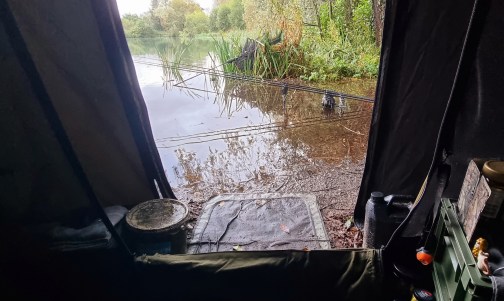
Another night passed without any carp action. The ongoing natural hatch, combined with the rain from the previous day, had raised the water level by around six inches and it was still rising. This presented a significant factor in my decision-making for the day. I would have to address this issue later in the morning. Carp were still visible in the vicinity, not too far from where Rob and I were positioned. Unfortunately, I didn’t have any significant signs of carp in the Car Park Bay anymore. I had a couple of bleeps late yesterday evening, but nothing more. I believed I was close to them, and my bait placement seemed perfect. Now, it was a matter of time and luck, and I wasn’t certain I had either in my favor. I could still hear water flowing through the pipe, which concerned me, as it was dangerously close to touching my bivvy mat and just eight inches away from the overwrap. I believed it was time to move my bivvy and rods before it was too late.
The lake’s water level continued to rise, and after a lengthy discussion with Rob, a few phone calls with other syndicate members, and checking the weather and river conditions, which included a flood warning, we faced a tough decision. Despite our belief that we stood a chance of each catching a carp, common sense prevailed. We decided it was best to pack up and head home, as the river might flood our area. We didn’t want to risk our fishing equipment getting damaged or potentially being caught in rising waters in the early hours of the morning, incurring significant costs.
The process of packing up was wet and challenging, and the drive home, with heavy rain and traffic, was no less entertaining. I arrived home by 3:00 PM, drying out my gear, ready to head off to the Airfield Lake tomorrow morning.
Demystifying the Ronnie Rig: A Game-Changer in Carp Fishing
Introduction
Carp fishing has evolved over the years, with anglers continually developing new techniques and rigs to outsmart these elusive and wary fish. One such innovation that has gained widespread popularity in recent years is the Ronnie Rig. This blog will delve into the world of the Ronnie Rig, exploring its components, setup, and why it has become a game-changer in the pursuit of carp.
The Origin of the Ronnie Rig
The Ronnie Rig, also known as the Spinner Rig, gained its name from British carp angler Ronnie Deakin, who is credited with popularizing this setup. Ronnie’s creative approach to rig design has revolutionized the way anglers present their baits to carp, leading to increased success on the water.
Key Components of the Ronnie Rig
Hook: The Ronnie Rig typically uses a curved or semi-curved hook. Size and pattern can vary based on personal preference, but hooks in the range of size 4 to 10 are commonly employed.
Swivel: A small, high-quality swivel is attached to the hook’s eye. This swivel is crucial for attaching the hook link to the mainline and providing rotation to the bait.
Hook Link: The hook link material is usually a supple and flexible material like fluorocarbon or soft braided line. A length of 6 to 8 inches is standard.
Bait Screw or Ronnie Ring: The magic of the Ronnie Rig lies in this component. It’s a small, screw-like device that is threaded through the bait (typically a pop-up or bottom bait), allowing it to rotate freely. This rotation adds an enticing movement to the bait.
Bait: The Ronnie Rig is highly effective with both pop-up and bottom baits. Popular choices include brightly colored pop-ups or critically balanced bottom baits.
Setting Up the Ronnie Rig
Thread the Swivel: Pass the swivel through the eye of the hook and secure it with a knotless knot, ensuring that the hook points toward the bait.
Attach the Hook Link: Attach the hook link to the swivel using a loop-to-loop connection or a knotless knot.
Add the Bait Screw or Ronnie Ring: Thread the bait screw or Ronnie ring through your chosen bait. Ensure it’s positioned in the center so that the bait can rotate freely.
Position the Hook: Carefully mount the bait onto the hook, ensuring that the point remains exposed. The curved shape of the hook helps with effective hooking.
Why the Ronnie Rig Works
The Ronnie Rig has gained a reputation for its effectiveness due to several key factors:
Natural Presentation: The rotating bait screw or ring imparts a lifelike, spinning action to the bait, making it appear more natural to the carp. This movement can trigger curiosity and entice feeding.
Hooking Efficiency: The curved hook and exposed point increase hooking efficiency, resulting in more successful hookups.
Anti-Eject Properties: The Ronnie Rig’s setup makes it challenging for carp to eject the bait without getting hooked.
Versatility: This rig is versatile and can be used with a variety of bait types and sizes, making it adaptable to different fishing scenarios.
Conclusion
The Ronnie Rig has undoubtedly left its mark on the world of carp fishing. Its innovative design, natural presentation, and hooking efficiency have made it a go-to choice for many anglers seeking an edge in their pursuit of carp. Whether you’re a seasoned carp angler or just starting out, the Ronnie Rig is a rig worth exploring to enhance your chances of landing these elusive and prized fish. Remember to adapt your setup based on the specific conditions and preferences of the carp in your chosen fishing location. Happy angling!

 NEW FEATURES on Fish Deeper Premium subscription!
 On-shore Fishing Spots || Our sophisticated data-driven algorithms will now suggest potential locations where honey holes can be located from the bank. A game changing feature when it comes to planning your session or when you want to change the spot and need a quick decision!
 7-DAY TRIAL || Yes, you can put these features to a test completely free for a week! Make sure to activate your Premium access the next time you’re planning to hit the water!








 video
video







 UK Carp & Coarse Fishing